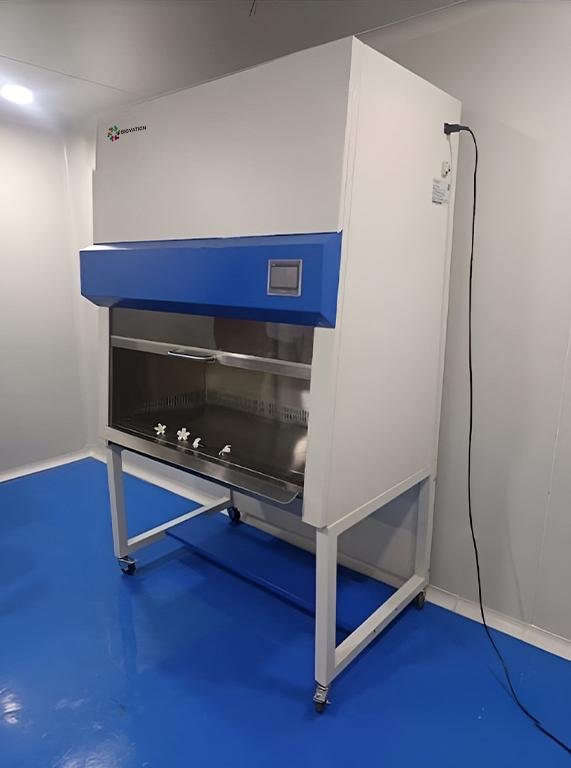
Laminar air flow
Laminar Air Flow cabinet is a laboratory device designed to provide a clean, sterile working environment by directing filtered air in a uniform flow. It is widely used in microbiology, pharmaceuticals, biotechnology, and medical laboratories where contamination control is critical.
The primary function of a laminar air flow cabinet is to protect samples from airborne contaminants such as dust, microbes, and particles. It uses High-Efficiency Particulate Air (HEPA) filters to remove up to 99.97% of particles as small as 0.3 microns. The filtered air then flows in a smooth, unidirectional (laminar) stream across the workspace, preventing contamination.
There are two main types of laminar air flow cabinets: horizontal and vertical. In horizontal flow cabinets, air moves from the back of the unit toward the user, while in vertical flow cabinets, air flows from the top downward onto the work surface. Both types are designed to maintain a sterile environment, though their applications may vary depending on the nature of the work.
Modern laminar air flow systems are equipped with features such as UV sterilization, digital control panels, airflow indicators, and safety alarms. These features enhance efficiency, ensure consistent performance, and help maintain strict hygiene standards.
In conclusion, a laminar air flow cabinet is an essential tool for contamination-free work in laboratories. By providing a controlled and sterile environment, it helps ensure accuracy, safety, and reliability in sensitive experiments and processes.